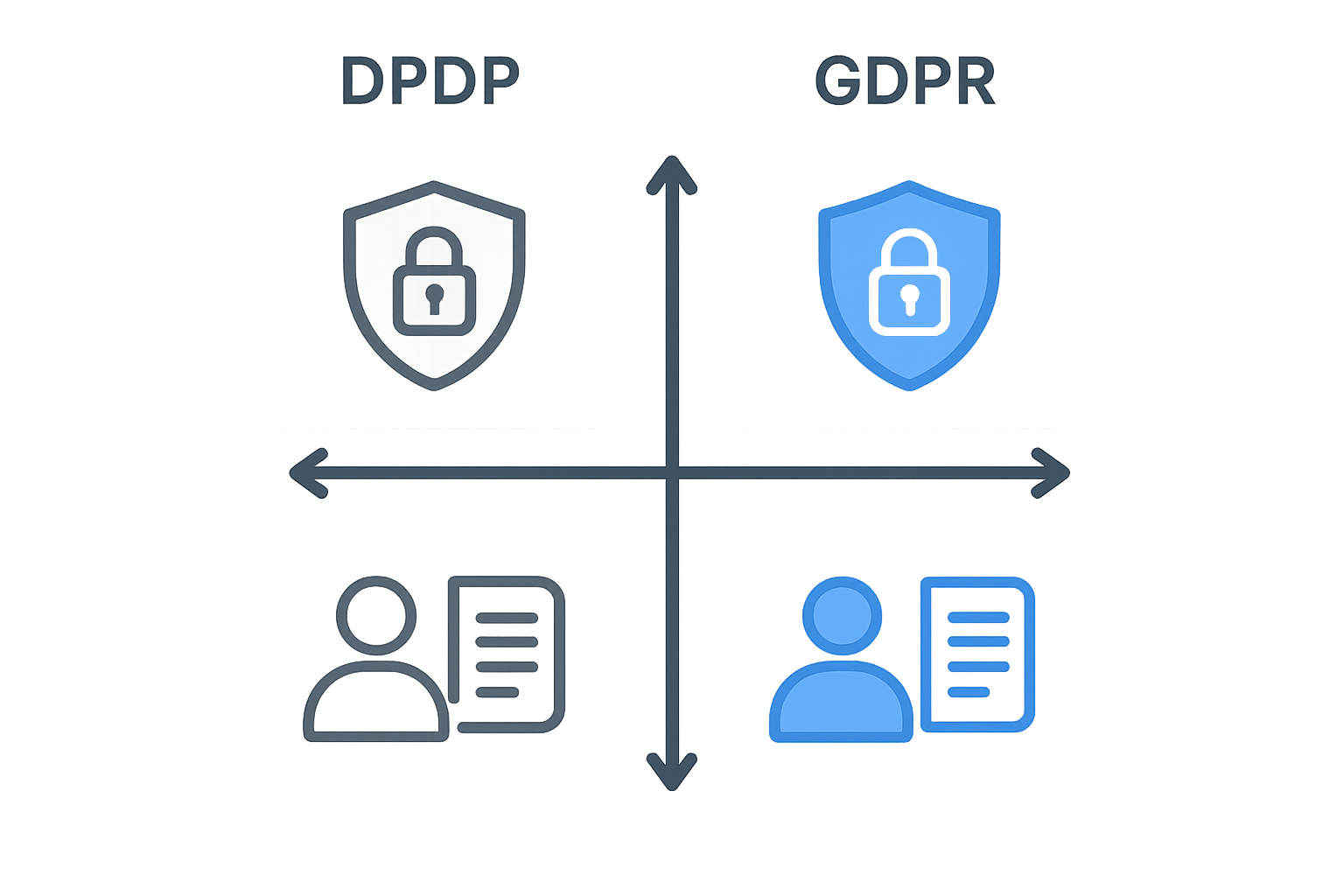
As India introduces the Digital Personal Data Protection (DPDP) Act, 2023, businesses face the challenge of understanding how it compares with the well-established European Union's General Data Protection Regulation (GDPR). This article provides a detailed comparison of DPDP vs GDPR, highlighting key differences, similarities, and what Indian businesses must know to ensure compliance in a complex regulatory environment.
Overview
The GDPR, enacted in 2018, is a comprehensive data protection framework governing personal data processing across the EU and beyond. It emphasizes individual rights, strict consent requirements, and heavy penalties for non-compliance. The DPDP Act, effective from 2023, reflects India's approach to data protection, balancing privacy rights with the country's digital economy needs. While inspired by GDPR, DPDP incorporates unique provisions suited to India's socio-economic context, including data localization and government oversight mechanisms.
Use case comparison
- GDPR applies broadly to entities processing EU residents' personal data, including foreign companies, emphasizing extraterritorial reach.
- DPDP primarily governs data fiduciaries operating in India or processing Indian residents' data, with specific exemptions for government agencies.
- GDPR mandates explicit consent for most data processing activities, with stringent rules on profiling and automated decision-making.
- DPDP allows processing for reasonable purposes beyond consent, such as legal compliance and public interest, reflecting pragmatic flexibility.
- Both laws grant individuals rights like access, correction, and erasure, but DPDP includes additional provisions for grievance redressal tailored to India's administrative framework.
Decision matrix
- GDPR dominates when dealing with EU personal data due to its extraterritorial enforcement and higher penalties.
- DPDP is the only choice for compliance within India's jurisdiction, especially for domestic data processing and local businesses.
- For multinational companies, GDPR compliance is mandatory for EU data, while DPDP compliance is essential for Indian data, requiring dual compliance strategies.
- GDPR's stricter consent and data subject rights requirements mean it wins when privacy prioritization is paramount.
- DPDP wins when balancing regulatory compliance with India's unique digital ecosystem needs, offering some operational flexibility not present in GDPR.
Cost & scaling impact
- GDPR compliance often entails higher costs due to extensive documentation, Data Protection Officer (DPO) mandates, and stringent audit requirements.
- DPDP compliance costs may be lower initially but could rise with evolving regulations and enforcement practices.
- Scaling operations across borders requires integrating both GDPR and DPDP compliance frameworks, increasing complexity and resource allocation.
- DPDP's provisions on data localization may increase infrastructure costs for Indian businesses handling cross-border data.
- GDPR's fines and reputational risks can impose significant financial burdens, incentivizing proactive investment in compliance technologies and training.
Failure tradeoffs
- Non-compliance with GDPR risks severe fines up to 4% of global turnover and bans on data processing, impacting international business.
- DPDP violations may result in penalties, including fines and imprisonment, but enforcement is evolving and may be less aggressive initially.
- GDPR breaches often attract global media attention, affecting brand reputation more severely than DPDP breaches.
- DPDP's enforcement allows some government discretion, which can lead to uncertainty but also potential leniency in certain cases.
- Failure to comply with either law can disrupt business operations, but GDPR's extraterritorial reach means ignoring it is rarely a viable option for global players.
Final recommendation
For Indian businesses, the clear choice is to prioritize DPDP compliance as the default regulatory framework within India. However, if they process data of EU citizens or operate internationally, GDPR compliance becomes non-negotiable and often dominates due to its stringent requirements and penalties. Organizations should develop integrated compliance programs that address both DPDP and GDPR, leveraging DPDP's flexibility where possible but adhering strictly to GDPR mandates for EU data. Choosing to implement GDPR standards across the board can simplify compliance but may increase costs; thus, a risk-based approach tailored to data flows and business models is advisable.
Conclusion
In conclusion, while DPDP and GDPR share the common goal of protecting personal data, their differences reflect distinct regulatory philosophies and operational contexts. Indian businesses must understand these nuances to navigate compliance effectively. By recognizing where DPDP offers flexibility and where GDPR demands rigor, organizations can optimize their data protection strategies, mitigate risks, and build trust with customers both in India and globally.